Hz ↔ note with cents meter
Type any frequency and read the nearest note plus its exact cents deviation on a live tuning gauge. Go the other way too — pick a note and octave, get the precise Hz.
Turn any Hz into its musical note — and back — with a live cents meter, harmonic-series explorer, audible reference tones, and the full equal-temperament table. Selectable A4 from 432 to 444 Hz.
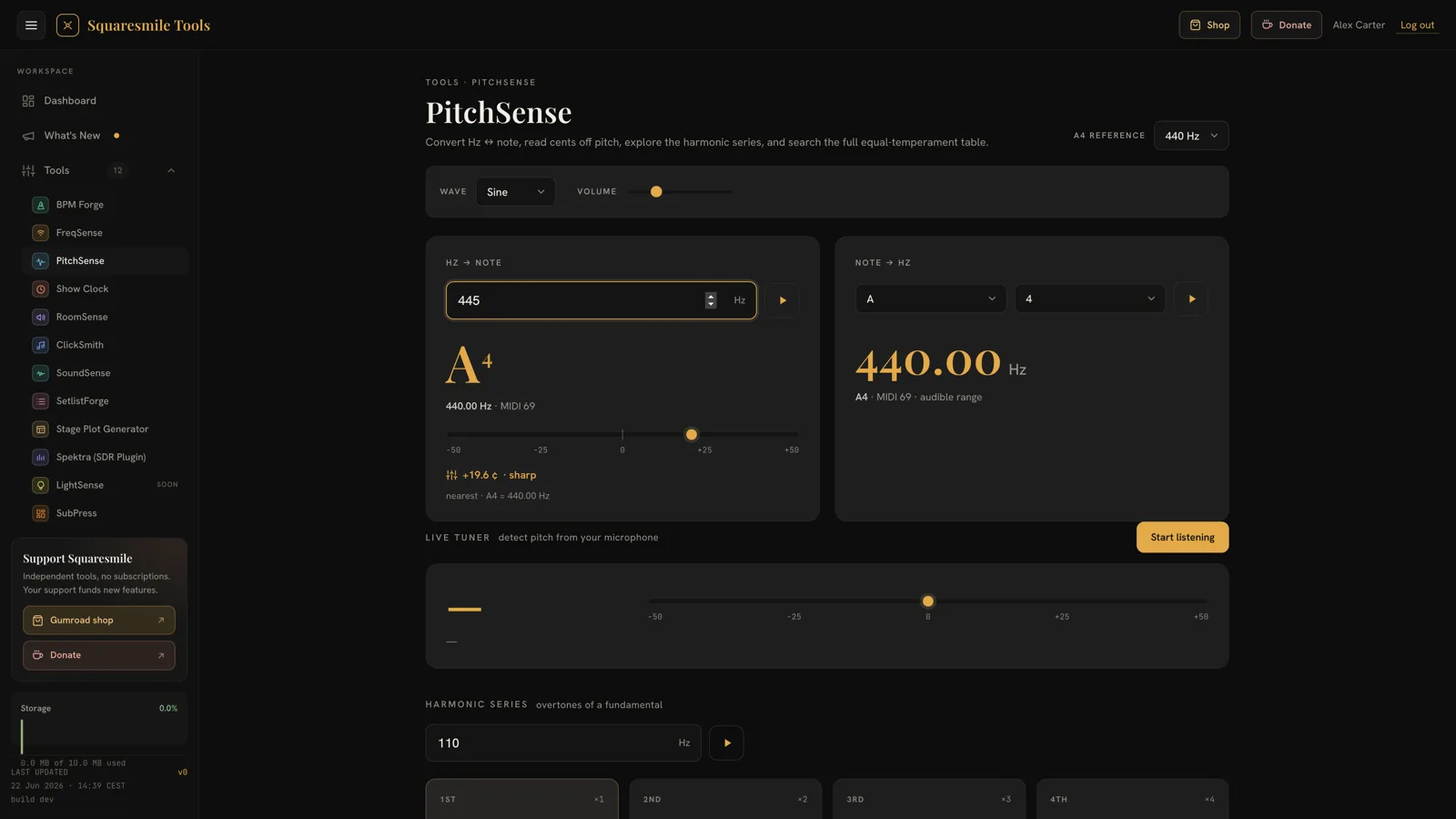
Hz → Note
Everything in one tool
Hz ↔ note, cents, harmonics, reference tones, and a searchable note table — all recalculated around the concert pitch you choose.
Type any frequency and read the nearest note plus its exact cents deviation on a live tuning gauge. Go the other way too — pick a note and octave, get the precise Hz.
Enter a fundamental and see its overtones — frequency, nearest note, and cents offset for each harmonic, with a playable tone on every card.
Every result plays a clean sine reference straight in the browser. Tune an instrument by ear or A/B two pitches instantly. No plugins, no latency.
Start listening and play — the built-in tuner detects pitch from your microphone and shows note, frequency, and cents on the live gauge. Audio never leaves your device.
The complete equal-temperament chart from C0 to B8 — searchable by note, MIDI number, or frequency, with one-tap playback on every row.
Switch concert pitch between 432 and 444 Hz in 2 Hz steps. Every conversion, harmonic, and table value recalculates around your reference.
Runs entirely in your browser. No upload, no tracking. Try the demo here with no account; the full tool opens with a free Squaresmile account.
Inside the full tool
One honest screenshot: type 445 Hz and the converter reads it as A4, 19.6 cents sharp on the gauge — with the exact in-tune reference right below.
See it in action
These are live pieces of the tool — tap any tone to hear it. Nothing is a screenshot.
01 · Harmonic series of 110 Hz
Each overtone is a whole-number multiple of the fundamental. Note how the 7th harmonic lands noticeably flat of equal temperament — the tool shows you exactly by how much.
02 · Reference table around A4
| Note | Oct | MIDI | Frequency (Hz) | |
|---|---|---|---|---|
| G | 4 | 67 | 392.00 | |
| G | 4 | 68 | 415.30 | |
| A | 4 | 69 | 440.00 | |
| A | 4 | 70 | 466.16 | |
| B | 4 | 71 | 493.88 | |
| C | 5 | 72 | 523.25 | |
| C | 5 | 73 | 554.37 | |
| D | 5 | 74 | 587.33 |
The full chart runs C0 to B8 and is searchable by note, MIDI, or frequency — with A4 highlighted as your reference row.
Who it's for
Dial in analog synths, tape machines, and acoustic instruments against an exact reference tone and cents readout.
Flip concert pitch and hear the difference for yourself — every note re-derived from your chosen A4.
Find the musical note behind a problem frequency, then notch or boost in tune with the material.
Show the harmonic series and equal temperament with audible, interactive examples students can play.
Confirm a feeding-back frequency's pitch in seconds, on whatever device is in your hand.
Build chords and intervals from precise Hz values and preview them without opening a DAW.
Dead simple
Type Hz, or pick a note and octave. Everything updates the instant you type.
See the nearest note, exact frequency, MIDI number, and how many cents sharp or flat you are.
Tap play for a clean reference tone — then explore harmonics and the full note table.
Good to know
It's a tool that turns a sound frequency in hertz (Hz) into its closest musical note, and back again. Enter 440 Hz and you'll see it's the note A4; enter a note and you'll get its exact frequency.
A cent is 1/100th of a semitone. The gauge shows how far your frequency sits from the nearest in-tune note — under ±5 cents reads as "in tune," anything more is sharp or flat. It's the standard unit for fine tuning.
A4 is the concert-pitch reference the whole scale is built from. 440 Hz is the modern standard, but orchestras and producers use everything from 432 to 444 Hz. Changing it re-derives every note, harmonic, and table value.
Yes. It's browser-native — once loaded it runs without a connection and works on phones, tablets, and laptops. Reference tones play through the Web Audio API with no plugins or installs.
Yes — PitchSense is one of the free tools on Squaresmile Tools. Try the live demo on this page with no account; the full tool opens with a free account — no credit card.
Conversions use the standard equal-temperament formula f(n) = A4 · 2^((n−69)/12) with full floating-point precision, and frequencies are shown to four decimal places in the reference table.
Open PitchSense and start converting — free, in your browser, no install.
The Squaresmile suite
Every browser tool below is free the moment you sign up. Create one account and the whole toolbox follows you from gig to gig — no installs, no app store.
Show day
 Show ClockPremium
Stage timer & run-of-show with 3 s crew sync
Show ClockPremium
Stage timer & run-of-show with 3 s crew sync
 Stage Plot GeneratorPremium
Stage plots, input lists & DMX patch in one doc
Stage Plot GeneratorPremium
Stage plots, input lists & DMX patch in one doc
 SetlistForgePremium
Setlists with timing, keys & royalty reports
SetlistForgePremium
Setlists with timing, keys & royalty reports
 RiderSmithPremium
Tech riders in 11 languages, assembled from your tools
RiderSmithPremium
Tech riders in 11 languages, assembled from your tools
Plan the rig
 RF CoordinationFree
Find safe wireless-mic windows for DE / UK / US / EU
RF CoordinationFree
Find safe wireless-mic windows for DE / UK / US / EU
 PowerSenseFree
Loads per phase, cable checks & distro headroom
PowerSenseFree
Loads per phase, cable checks & distro headroom
 RiggingSenseFree
Bridle & truss statics, taught step by step
RiggingSenseFree
Bridle & truss statics, taught step by step
 RoomSenseFree
Acoustic reference: room modes, SPL, LUFS & EQ
RoomSenseFree
Acoustic reference: room modes, SPL, LUFS & EQ
Train your senses
Studio & prep
 ClickSmithFree
Turn any song into an L/R click track (WAV)
ClickSmithFree
Turn any song into an L/R click track (WAV)
 BPM ForgeFree
Tap tempo, metronome, tuner & per-song setlists
BPM ForgeFree
Tap tempo, metronome, tuner & per-song setlists
Desktop & plugins


